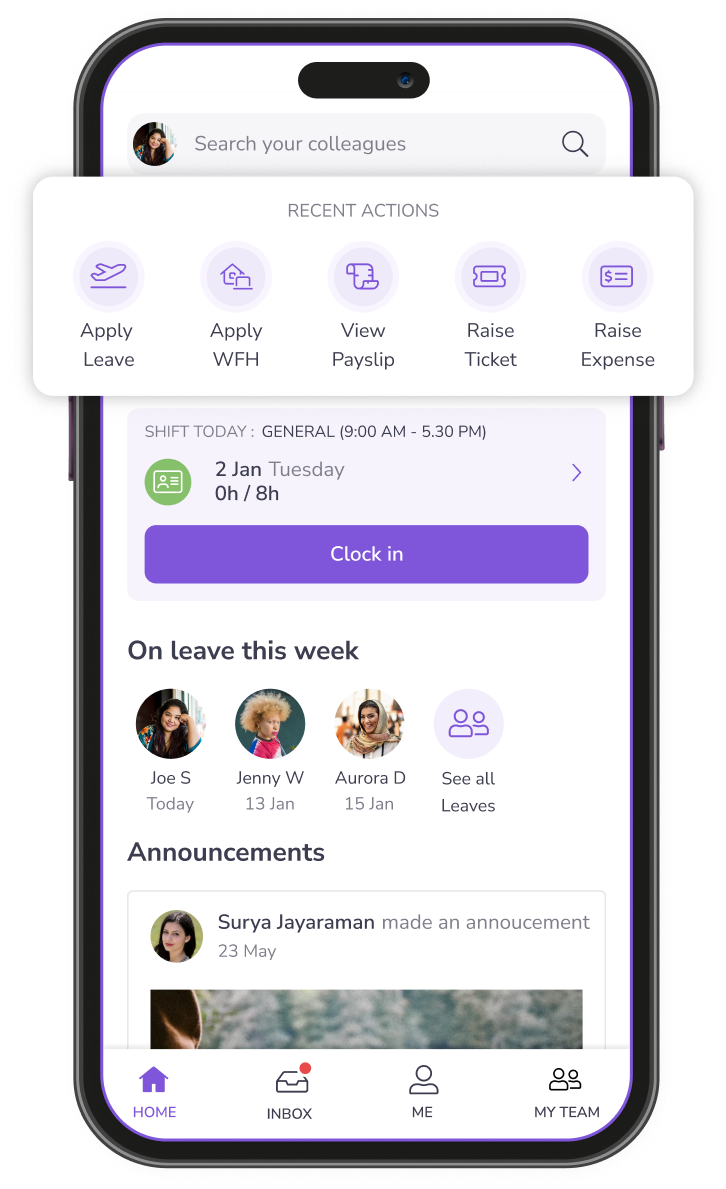
Measure where HR time actually goes and a large share is answering questions employees could answer themselves: what is my leave balance, where is my payslip, what did I declare for tax, can I get a salary certificate.
Self-service removes that queue. It is rarely the feature that sells a platform and it is usually the one that pays for it.
The arithmetic
A 200-person company typically generates 100 to 200 routine HR queries a month. At an average of eight minutes each including the interruption cost, that is 13 to 27 hours monthly — roughly a week of someone's time, spent on lookups.
💡 The interruption cost is the real cost
A two-minute query that interrupts payroll verification costs far more than two minutes. The error risk from broken concentration during payroll processing is the hidden part of this bill.
What employees should be able to do themselves
Pay and tax
- View and download current and historical payslips
- See the salary structure breakdown, so CTC questions answer themselves
- Submit and revise tax declarations, and choose a regime
- View the annual tax projection and what proof is still needed
- Download Form 16 for current and past years
- Generate salary and employment certificates for loan or visa purposes
Leave and attendance
- Current balance by leave type, with accrual visible
- Apply for leave and track approval status
- View their own attendance record, including regularisations
- Request regularisation of a missed punch
- See the holiday calendar for their location
- See team leave, to plan around colleagues
Personal data
- Update address, phone, emergency contact
- Request a bank detail change, routed through verification
- Upload documents
- Update nominations
Claims and requests
- Submit reimbursement claims with bill upload, and track status
- Raise an HR query with a ticket reference
- Access policies in their current version
What to keep out of self-service
- Direct bank detail edits. Always route through verification — this is the main payroll fraud vector.
- Anything requiring judgement. Grievances, disciplinary matters and personal circumstances need a person.
- Other people's data. Managers need team visibility; nobody needs peer salary visibility.
Driving adoption past the novelty period
Portals get used for a month and then abandoned when people revert to messaging HR. What works:
- Mobile first. Most employees will never open it on a laptop. If the mobile experience is poor, adoption fails regardless of features.
- Stop answering what the portal answers. Respond with the link and a short note. Kind but consistent redirection is the single most effective adoption lever.
- Notify, do not just publish. Push a notification when the payslip is available rather than waiting to be asked.
- Introduce it at onboarding. New joiners who start in self-service never form the habit of asking.
- Remove login friction. Single sign-on if you have it; simple password recovery if you do not.
- Watch the query log. Repeated questions about something available in the portal mean it is not findable, not that employees are lazy.
⚠️ The adoption killer
HR continuing to answer queries directly out of helpfulness. It is well-intentioned and it guarantees the portal stays unused, because asking is always easier than looking. Redirect consistently for one quarter and the habit shifts.
Measuring it
- Monthly active users as a percentage of headcount
- Routine query volume to HR, which should fall measurably
- Leave applications submitted through the portal versus other channels
- Payslip self-downloads versus requests
- Declaration submission rate before the deadline
✅ The transparency dividend
Beyond time saved, self-service reduces disputes. An employee who can see their attendance record, leave balance and salary breakdown throughout the month does not discover a surprise on payday. Most payroll grievances are really surprises.
📝 Final note
If you implement one HRMS module first, make it self-service with payslips and leave. It is the piece employees notice immediately, which also makes the rest of the rollout easier to sell internally.